Holiday lighting estimating software
Estimate the job from the design, not beside it
Every run you traced arrives as a priced line at your own rates. Nothing is measured twice, and nothing is typed into a spreadsheet a second time.
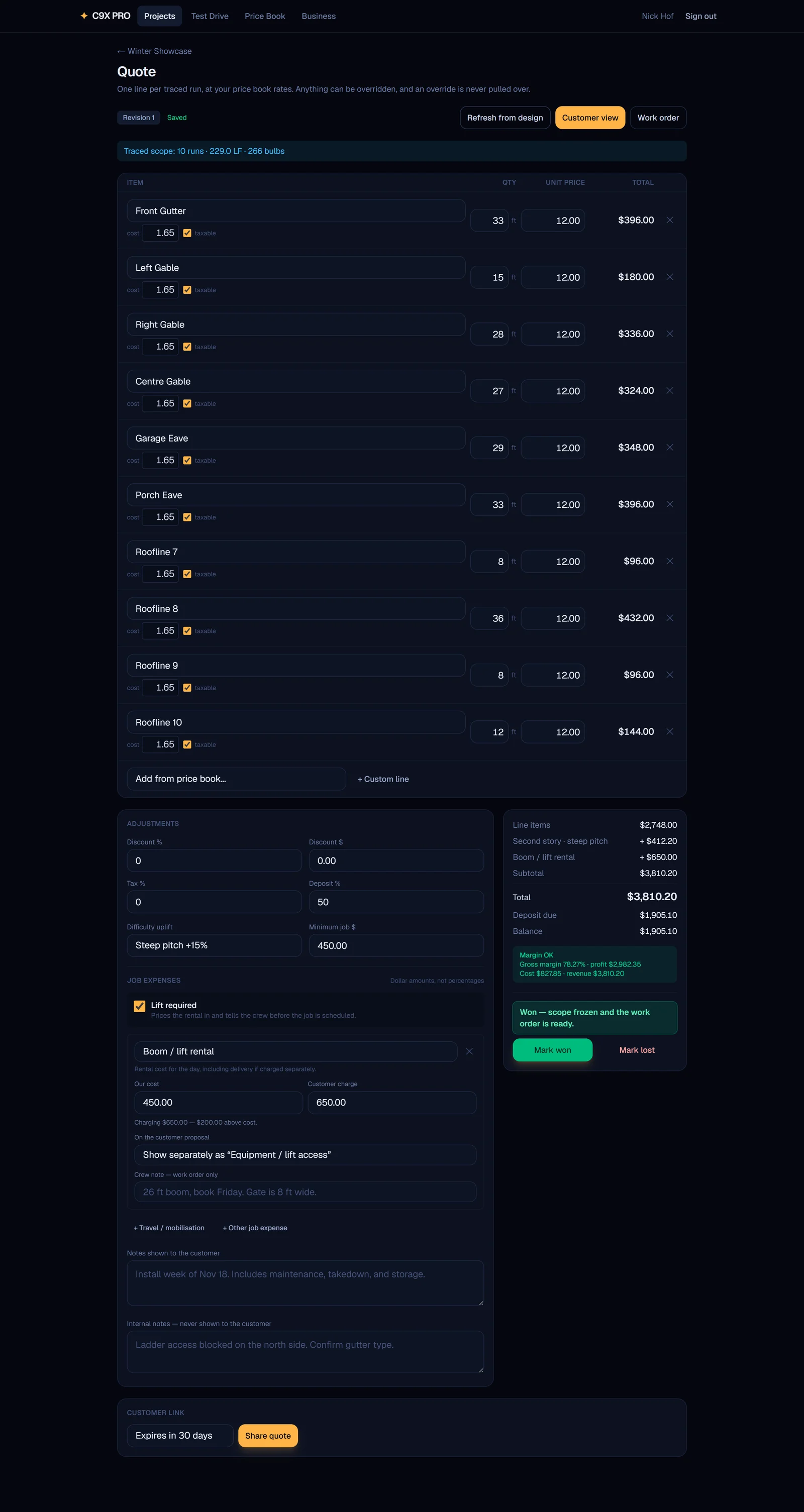
The house on this page priced at $2,748.00 of lighting, a 15% uplift for a second story and steep pitch, and $650.00 of lift — $3,810.20 total, with the margin visible while it was being built.
Already have an account? Log in to subscribe or manage your plan.
No credit card required. Full access for 14 days, and the trial does not convert — at the end of it access pauses until you choose to subscribe, and your projects are kept either way.
Choosing a plan starts a subscription — $69/month or $499/year — which renews automatically on that interval unless you cancel before the renewal date. Canceling stops the next renewal; the period you have paid for runs to the end.
Who this is for
The contractor whose estimate and whose install are working from two different numbers. Usually because the first was a measurement off a satellite image with a percentage added for safety, and the second was a tape measure on the day.
You already have a design tool that cannot price
A mockup that does not know the footage cannot cost the job, so the number still gets rebuilt somewhere else afterwards.
You pad the estimate because the measure is a range
A percentage added to cover the gap is the crew's problem later, and the customer's price now.
You want the margin before you send it
Not after the season, when the only thing left to do about a thin job is remember it next year.
01 — Line items
Every traced run becomes a line.
The quote screen is the design, priced. One line per run at your rates, beside adjustments, job expenses and a margin panel that moves as you work.
Your price book, not ours
Per-foot rates, material rules, minimum job, deposit percentage and tax are yours. It never quotes below what you set.
Difficulty as a percentage of the work
15% here for a second story and a steep pitch, applied to the labour it actually costs more to do.
Lift as a dollar amount
A lift costs the same on a small house as a large one, so it is an expense with your cost and your charge kept apart — not a rate per foot.
Three quantities, and why they are not one number
Most estimating goes wrong in the same place: one footage figure is asked to be the measurement, the invoice and the packing list at the same time. It cannot be all three, so it is wrong for two of them.
01
Measured
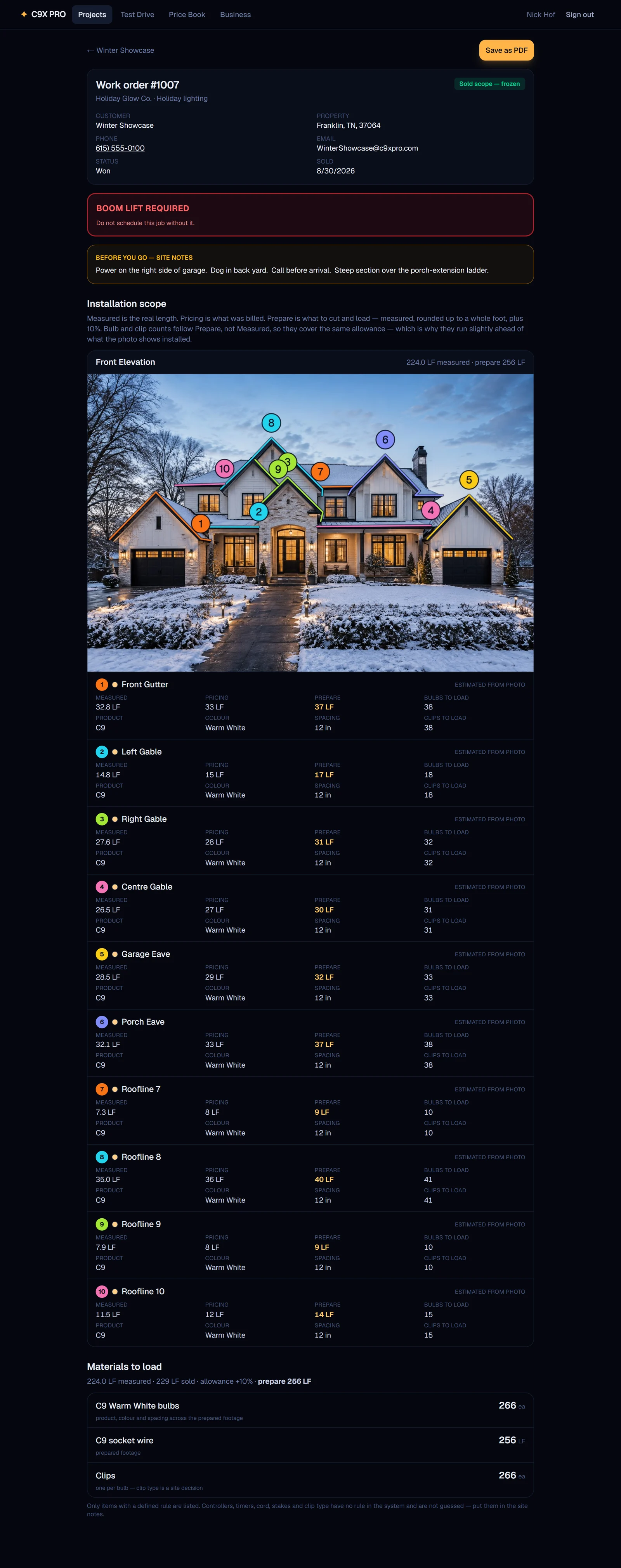
What the geometry says the run is, from the scale you set on the photo. The honest number, and the one nothing is allowed to overwrite.
02
Billed
What the customer is charged for. Yours to set where you round, bundle or hold a rate — visible as a separate figure rather than a quiet edit to the measurement.
03
Prepare
What the crew cuts and loads. Normally the largest of the three, and the one a job runs short on when an estimate hands the warehouse its measured footage.
02 — Materials
The bill of materials comes from the same runs.
The product, colour and spacing on each run determine its bulbs and clips. Because the estimate and the load list are read off one trace, what you bought and what you billed cannot drift apart.
Where this sits in the job
Estimating is the fourth step, and it is fast only because the second one produced real geometry. A design that is a picture leaves the pricing to be done from scratch; a design that is a set of measured runs arrives on this screen already itemised.
Before you ask us
Questions about pricing a lighting job
Where do the prices come from?
Your price book. C9X PRO does not ship with market rates and it will not quote below what you set. Your per-foot rates, material rules, difficulty uplift, lift charge, minimum job, deposit percentage and tax are all yours to configure, and the estimate is built from them.
What are measured, billed and prepare footage?
Three quantities that are usually collapsed into one and should not be. Measured is what the geometry says the run is. Billed is what the customer is charged for, which may differ where you round or bundle. Prepare is what the crew cuts and loads, which is normally the largest of the three. Keeping them apart is what stops a job being under-materialled because somebody quoted the measured number.
How do you charge for a hard house without punishing an easy one?
A difficulty uplift applies a percentage to the work itself — 15% on the example job here, for a second story and a steep pitch — because that is what genuinely costs more per foot. A lift is different: hiring one costs the same on an 80-foot house as a 400-foot one, so it is carried as a job expense with your cost and your charge held separately, not smeared across every foot.
Does it work out materials, or just footage?
Materials. The product and spacing on each run determine its bulb count and clip count, and the work order lists what to load at your allowance. Because the counts come from the same trace the price came from, the quantity you bought and the quantity you billed cannot quietly disagree.
Can I see margin while I am still quoting?
Yes — the margin panel updates as you price, alongside adjustments and job expenses. The point is to find out the job is thin while you can still change it, rather than in January.
Will the customer see my rates and footage?
No. The customer proposal is a separate document and it deliberately prints none of it — no per-run footage, no unit rates, no bulb counts, no job cost, no margin. See Christmas light proposals for what it does show.
Do I have to re-measure before the install?
That is the habit this removes. The crew work order is generated from the accepted estimate, run by run, so the footage the job was priced on is the footage the crew is given. There is no second measurement to reconcile against the first.
Does this replace my CRM or invoicing?
No, and it does not claim to. There is no scheduling, routing, payment collection or takedown module. It is the design-to-price-to-proposal step; whatever you already use to run the season keeps doing that.
Price a real house against your own price book.
Already have an account? Log in to subscribe or manage your plan.
No credit card required. Full access for 14 days, and the trial does not convert — at the end of it access pauses until you choose to subscribe, and your projects are kept either way.
Choosing a plan starts a subscription — $69/month or $499/year — which renews automatically on that interval unless you cancel before the renewal date. Canceling stops the next renewal; the period you have paid for runs to the end.
The rest of the same job
Measure once. Price from it.
The footage in the estimate, the materials on the truck and the runs the crew installs are the same numbers, because they are read from the same traced design.
No credit card. Full access for 14 days, and the trial does not convert — access pauses at the end of it until you choose a plan, $69/month or $499/year, each renewing on that interval unless cancelled. Your projects are kept either way.